
Is Underglow Legal in Texas? Are Smoke Lights Legal?
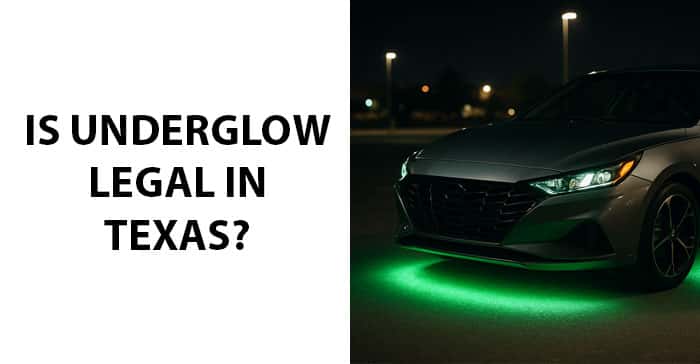
Texas law does not explicitly ban underglow (neon or LED under-car lighting) in all situations. However, the Vehicle Code, in Chapter 547 (Vehicle Equipment), places significant restrictions on vehicle lighting, and underglow systems must comply with those rules or risk a traffic stop or ticket.
So is underglow legal in Texas? The short answer is “yes”, but with strict limits.
How Much Is Texas Car Sales Tax? The Selling A Car In Texas Guide
Key Statutes & Provisions For Texas Underglow
- Section 547.305 (Restrictions of Use of Lights) states that nonstandard lamps (i.e.anything other than headlamps, auxiliary turn signals, etc) that project intense beams must be directed so that the high-intensity portion of the beam does not strike the roadway more than 5 feet ahead of the vehicle.
- That same section also prohibits a person (other than an emergency vehicle) from operating a vehicle with a lamp or device that displays a red light visible fro directly in front of the vehicle.
- Also, flashing, rotating, oscillating, or alternating lights (red, blue, white) are prohibited unless specifically authorized by law (mainly for emergency vehicles).
- Texas DPS (Vehicle Inspection) rules also require that lighting equipment meet federal standards (DOT or SAE markings) and that aftermarket “colored bulbs” (especially red) be DOT/SAE approved for inspection acceptance.
- Texas law explicitly permits certain “other lamps” under Section 547.332 such as side cowl/fender lamps and running board courtesy lamps (amber or white) without glare.
Thus, underglow is allowed insofar as it does not conflict with these provisions (i.e. does not emit prohibited colors, flash, or interfere with standard lighting).
What Underglow Colors Are Legal (and Illegal) in Texas?
Because underglow is treated as an “auxiliary” or additional lighting device, it must obey the color restrictions in the Texas code.
- Forbidden colors/situations: A vehicle may not display a red light visible from directly in front (ie. you can’t have red underglow shining toward the front).
- Flashing, rotating, or oscillating lighting patterns (especially in red, blue, or white) are disallowed for private vehicles unless specifically authorized.
- Blue underglow is strongly discouraged because blue (and red) is generally reserved for emergency and law enforcement vehicles. Some sources say blue is prohibited completely for underglow.
- Safe/commonly accepted colors tend to be white and amber (non-flashing) for most underglow use.
- For motorcycles,Texas statute 547.306 specifically allows LED ground effect lighting (i.e. underglow)on motorcycles if it emits a non-flashing amber or white light.
- That means for bikes, you cannot use red or blue underglow or flashing effects legally.
In practice, many car enthusiasts stick with solid white, amber, or other “safer” colors (green, purple, etc) while being mindful of enforcement risk.
Placement, Visibility & Use Restrictions
- Underglow lighting should generally illuminate the ground beneath the vehicle rather than projecting outward,upward,or in a way that interferes with other drivers’ visibility or mimics the position of turn signals, brake lights, etc.
- The lighting must not obstruct or impair the required standard lighting (headlights, tail lights, turn signals, reflectors). Texas law prohibits any device that impairs the effectiveness of those.
- Nonstandard lamps of high intensity (less than 300 candlepower) must be aimed such that no high-intensity beam portion strikes the roadway more than 75 feet ahead. (From 547.305).
- Underglow should not flash or alternate (oscillate) while driving on public roads (except in very specific, authorized emergency scenarios).
- Some local ordinances (cit of count) may impose additional restrictions, so you must check local law in our city.
In effect: you can run underglow lights, but keep them static (solid), properly aimed, non-interfering, and in colors that do not mislead other drivers.
The Requirements To Pass a Vehicle Inspection in Texas
When & Where Lights (Underglow/Smoke) May Be Used
- On public roads, underglow lighting is permitted only when compliant with the rules above: static (non-flashing),non-redfront, no interference, properly aimed.
- In some cases, underglow or decorative lighting may be safer to turn off while driving on public streets to reduce risk of citation or enforcement scrutiny.
- Off-road, at car shows,or in private proper settings, you may use more creative lighting (flashing, color-changing, etc.)—but once you put the car on public roads, you should revert to legal mode.
- Some city or municipal codes may prohibit or restrict visible decorative lighting, particularly at night, so always check local rules.
- In many cases, law enforcement may allow a “fix it ticket” (i.e. remove or cover noncompliant lighting) if corrected before our court date.
Are Underglow/Smoke Lights Legal on Motorcycles?
Yes—Texas explicitly allows LED ground effect lighting (i.e. underglow on a motorcycle) provided it emits a non-flashing amber or white light.
- Motorcycles may not use red or blue underglow (or flashing effects).
- The same rules about not impairing required lighting (brake, headlamp, turn signals) apply.
- Smoked/tinted tail lights on a motorcycle are subject to the same visibilit and compliance concerns as on cars.
Penalties for Violations
Violating lighting regulations in Texas (including underglow or smoke light infractions) is generally considered a misdemeanor under the Texas Transportation Code.
- A first offense typically carries fines in the Class C misdemeanor range (for example, up to $200) for noncompliance.
- Some sources claim fines up to $350, or for repeat violations up to $1000, though that may depend on jurisdiction and severity.
- Courts may dismiss a citation if the vehicle owner remedies the defect before first court appearance and pays a small administrative fee (e.g. under $10).
- In some cases, law enforcement may order the removal of noncompliant lighting, suspend registration until corrected, or impound the vehicle until fixed.
- More serious violations (lighting that misleads or contributes to a safety hazard) could result in escalated penalties or civil liability.
Because local jurisdictions may enforce lighting rules differently, penalties could vary by city or county.
Is Underglow Legal in Texas? Conclusion
If you’re considering adding underglow or smoked lighting to your vehicle in Texas, here’s the bottom line:
- Underglow is not strictly illegal in Texas, but it must comply with Texas’s lighting laws.
- Red (visible from front), flashing, rotating, or oscillating lighting is typically prohibited.
- White or amber underglow (static) is our safest choice; for motorcycles, only non-flashing amber or white is allowed.
- Smoked tail lights are risky because they may reduce required visibility and attract inspection failure or citation.
- Always check local (city/county) ordinances in addition to state law.
- Be ready to alter or disable your lighting while on public roads if needed; compliance is key to avoiding fines.
If you want professional installation, guidance, or want to outfit your car or motorcycle correctly without risking legal issues, come see us at Tipton Hyundai in Brownsville, Texas. Our experienced service team knows the state and local lighting rules, and we can help you pick and install underglow, smoked lights, or any accessory in a way that maximizes your style and stays street-legal. Stop by Tipton Hyundai and let us get your ride shining, the right way! We serve customers all over the state, including Harlingen, McAllen, Mission, and even ship to Dallas and Houston. We can also help you with all your auto repair and car service needs including oil changes, ac repair, new tires, and transmission repair.
0 comment(s) so far on Is Underglow Legal in Texas? Are Smoke Lights Legal?